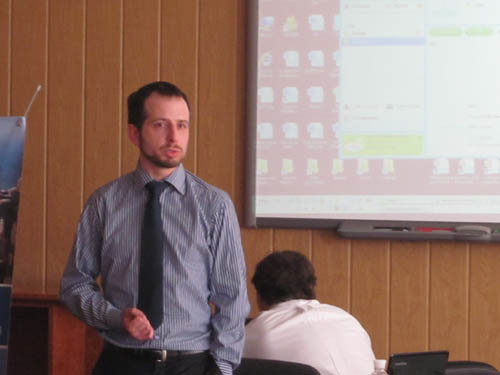
Property Rights and Ukrainian Identity

I gave this lecture on April 19th, 2011.

Property Rights and Ukrainian Identity Lecture

Property Rights and Ukrainian Identity:

http://romaninukraine.com/Stuff/RomanSkaskiw_PropertyRightsNUkrainianIdentity.mp3

– In the lecture I make the case against coercive means to support the Ukrainian culture and language. I made two points afterwards which strengthened and elaborated on my case. Firstly, that coercive institution can easily be turned against Ukrainian culture and language. This is already happened through the policies of Ukraine’s Russophile education minister. Secondly, that people interested in supporting the Ukrainian culture and language should do as I do, and voluntarily donate money to cultural organizations. Even more importantly, people should vote with their wallets, and buy embroideries, museum and theater tickets, they should patronize nightclubs which play the type of music they like, and so on — your patronage supports exactly the aspects of Ukrainian culture which you find important.

– I also made a reference to two forces likely supporting the hryvnias peg to the U.S. dollar, but I only mentioned one, the IMF. The second is the power and influence of the country’s biggest oligarchs, who are all exporters. Exporters benefit in the short run from a weakening currency, as I discuss in this essay.

– I misspoke. On the wall hung Taras Shevchenko’s portrait, not photo.

Q & A:

http://romaninukraine.com/Stuff/RomanSkaskiw_PropertyRightsNUkrainianIdentity-QnA.mp3

– If my goal was to convince conference attendees that a more libertarian respect for property rights ensures a better future for all, then perhaps I committed a tactical mistake. I should have stuck to the more conventional position of advocating more regional autonomy and local self-governance, but I was asked what system I support. I mentioned privatizing security and with that, we all jumped head first into the deep end of the anarcho-capitalist swimming pool. I did the best I could, working from memory.

– I misspoke at one point, saying Iowa instead of Hawaii. The political scientist who calculated that over 100 million people (172 million, actually) were killed by their own governments during peace time, was the University of Hawaii’s Rudolph Rummel. There is also the KGB admission during Glasnost that 43 million Soviet citizens were killed, another estimate that 60 million Soviet citizens were killed, and Little Black Book of Communism which calculates that over 100 million people were killed by Socialist governments.

Economic Outlook

This was publish in Media Star’s newspaper and elsewhere.

here.

***

It is difficult to contemplate the enormous extent to which the world changed when the Soviet Union collapsed. The more economists and historians study the Soviet Union, the more apparent it becomes that it existed as a house of card built upon economic fallacies and that its collapse was inevitable.

We should remember, however, that the economic fraud of Soviet central planning is not only known historically, in retrospect. It was predicted before it happened. Based strictly on a theoretical understanding of human action, in other words, of economics, the eventual collapse of the Soviet Union was apparent to L’viv-born, Austrian School Economist, Ludwig Von Mises.

In 1921, before Lenin was even forced to restored partial property rights through his New Economic Policy (Novaya Ekonomicheskaya Politika ), Mises criticized central planning in a book entitled “Socialism.” He predicted not only that the Soviet Union’s collapse, but that it would eventually have many factories and empty stores. His reasoning was simple: without market prices, society is blind to its true desires.

We are now facing a second collapse which may alter the world as much as the collapse of the Soviet Union did — the collapse of the dollar. Using a similar theoretical understanding of human action, economists of the Austrian School unanimously predict the dollar’s collapse. The reason is also simple and should be self-evident: the United States government cannot stop printing money.

The intellectual work of the Austrian School is largely devoted to unmasking the many euphemisms the government and its apologists use to conceal this fact: economic stimulus, quantitative easing, liquidity traps.

The exact date of the dollar’s collapse is not only unknown, but unknowable. As Mises noted, an objective way of determining the date of a significant economic event cannot exist because the knowledge itself would change the date of the event.

For example, if we could determine that the dollar was going to lose half its purchasing power on Friday, this would cause people to spend dollars as quickly as possible on Thursday, changing the date of the collapse. Theoretically, however, it is clear that the United States government will be forced to chose between destroying the dollar and defaulting on its debt, and default appears out of the question.

It is very likely that the hryvnia will collapse along with the dollar. The price increases plaguing Ukraine are at least partially (perhaps totally) attributable to the country’s monetary policy. By keeping a fixed exchange rate between hryvnias and dollars, Ukraine’s central bank imports inflation from the United States.

There are probably two reasons for this monetary policy. First, Ukraine’s government is dependent upon IMF loans to avoid it’s own long-overdue default. The IMF promotes dollar-friendly policies. The more inflation gets exported to other countries, the longer the collapse of the dollar can be delayed, and the further the gravy-train of printed money can carry the vast bureaucracies of government. (In the United States, one of out six people works for government.) It is likely that the IMF pressures Ukrainian monetary policy.

Secondly, large industries which export their products benefit in the short term from a devalued currency, and many of Ukraine’s most influential people are industrialists who rely on exports. They may also be pressuring the Central Bank of Ukraine to import inflation from the United States. It is important to remember, however, that they only benefit in the short term. In the long term, all of society suffers under the skyrocketing prices and the chaos they create.

The question remains, what to do about this?

For individuals, both dollars and hryvnias should be treated like the hot potato in the similarly named children’s game. Do not get caught holding a large amount of dollars or hryvnias when the music stops. People who have worked hard and lived modestly and want to preserve the value of their savings for the distant future should find ways of doing so that do not involve keeping large quantities of currency.

For society, we should distinguish between what Austrian School economist F.A. Hayek called the voluntary, private-sector economy and the coercive, public sector economy. He called the public sector economy coercive because it runs on taxes which are collected by force.

After the collapse of the dollar, the voluntary sector of the economy will go through a difficult time as it finds a new medium of exchange. Where currencies have collapsed, cigarettes, cows, flour, and bottled water have served as temporary mediums of exchange. Gold have silver almost always emerge as the voluntary choice when a society isn’t forced to use its government’s currency.

The private sector will recover naturally and peacefully because people will still want all the goods and services it produces — food, clothing, entertainment, books, technology, travel. Those businesses who fail to produce goods and service which others want at prices they are willing to pay will go bankrupt, and their land, labor and capital goods will eventually be incorporated into more productive enterprises.

By contrast, the coercive sector of the economy will recover neither naturally nor peacefully because it doesn’t produce goods and services which people voluntarily consume. They run on money which is collected by force or printed. Look for the vast bureaucracies of governments all over the world to suddenly find themselves starved for money, and look for all manner of demagoguery as they attempt to justify their existence and reimpose another system of wealth extraction upon the private sector of the economy.

The recent protests in Greece and in the U.S. state of Wisconsin were protests by government workers and their economically misguided allies against fiscal responsibility. They are a premonition of what is to come on a much larger scale.

Preserving bloated, unnecessary, inefficient government bureaucracies, will make everybody, including those protesting, poorer. Forcing these people to enter the voluntary sector of the economy and to produce goods and services which you and I will voluntarily pay for will make everyone richer. Those who contend that there is a limited number of jobs in the world over which we must all compete are wrong. The only limit to the number of jobs in the world is the number of needs and desires felt by humanity. In other words, none whatsoever.

Perhaps the most important question of our time is what comes after the dollar’s collapse. The rather obscure question of whether people will be free to choose their own medium of exchange, or if another printable, government currency is imposed on society by the brute force of law is a question between freedom and slavery. It is too late to save the dollar. I hope it is not too late to educate society about the nature of money.

***

Roman Skaskiw Media Start Article Roman Skaskiw Media Start Article

The Ghostly Bandurist of Desyatynna Street

Published in the April 3rd, 2011 issue of the Ukrainian Weekly.

During my recent visit to Kyiv, I veered off the touristy Andriivs’kyi Descent, and walked down Desyatynna Street, hoping to find the Bandurist I had once seen playing there. Desyatynna is a very unspectacular street. The sounds of the merchants at their tourist shops on Andriivs’kyi fades as you walk. It is residential. From an apartment of one building hung a sign protesting the construction of additional units on the roof. The street gets more interesting when it dead-ends into the parking lot of the imposing, Soviet-style Ministry of Foreign Affairs, not far from St. Michael’s Golden-Domed Monastery, but I only walked to where I had once seen the ancient Kobzar. As on my previous four or five attempts, there was no sign of him.

I’d seen him only once, and now wonder if he wasn’t a ghost. There are many more ghosts wandering over Ukraine’s black earth than over the U.S. I don’t know how to describe it to my American friends. Perhaps it can be understood by Southerners and Indians, by the losers of wars. Those ghosts, half in the wind, half in your blood, press you with that lonely urgency. You sense some critical knowledge which nobody’s telling you, as if you missed a day of school and are now condemned to stumble on in confusion.

It is a rare thing when one of them speaks to you.

I saw him in November. Small, sharp drops of cold rain had just begun falling through the wind. I actually walked past him, coming within several steps without noticing him. Then I heard a tinkling in the wind, bells you might associate with angels or the souls of babies. I turned and saw the ancient man.

His sun-baked cheeks were sunken, and eyes half shut. He looked so emaciated, my first thought concerned whether or not I should seek medical attention for him. The grey ends of his mustache curled off his face, and blew in the wind beneath his chin as I wondered what to do. His fingers were gnarled like roots, with thick, brown finger nails. They seemed to barely move over the strings of his bandura, perhaps having learning efficiency over several lifetimes of practice. I saw all this before I heard him, as he played very quietly.

The street was empty except for us. I would have liked a second opinion, a verification of sorts. Some magic in the sounds he produced held me frozen in place.

The wood of his instrument was blackened where his fingers gripped it, and the strings too were black with grime except for where he plucked them. There, the strings shone as brightly as the domes of St. Michael’s Monastery. He wore a great wool hat, and an over-sized coat. I felt so absorbed by this strange apparition that it was his ragged velcro sneakers which seemed anachronistic, rather than the man himself. A melodic groan blew from his skinny neck, and I stepped still closer.

Between breaths he opened his eyes slightly and seemed to take me in without giving anything back, never interrupting his ancient song. I leaned even closer, tilting my good ear toward him. It seemed he sung of a young girl whose lover will not return from war, children begging for bread, and a solemn line of horsemen and the grasses of the endless steppe opening then closing behind them like water. The sounds unwinding from his strings contained the rocking of slave ships on the Black Sea, devastated cities, and a mother whose children are condemned to work foreign lands. There were Scythian Mounds, torn open graves, betrayal and forgotten glory. There were people hiding in their gardens with the wagon cars outside, and the ashes of a library.

If I could only have listened longer, taken a seat at his torn, velcro sneakers and listened, I might have learned that missing bit of knowledge for which I’ve been so hungry, that elusive clarity. The movements of his long-practiced fingers to retell the stories and glories consumed by fire, reignite the lights vanished by darkness. It was all there, but I woke up. I startled awake, as if from a dream.

The ghost had vanished in the wind. I stood over the withered Kobzar. He played on, but my usual reality crept back into my thoughts, crowding him away. Some important obligation — I don’t remember what — compelled me to move on. I made a mental note to return to that spot, thinking, idiotically, that I could capture all the loneliness and history with my digital camera and post it on this blog.

Regardless of how futile it would be, I’ve returned five or six time now with no luck. If I do come across the ghost again, I hope I’ll find the courage to sit at his feet and listen.

Bukovel Resort: Skiing the Carpathian Mountains in Ukraine

What interested me most about my recent visit to Bukovel, Ukraine’s only major ski resort, was the rapid, uneven development of the resort and the region. Bukovel is located 240 km from L’viv, where I lived during my 2010-2011 Fulbright Scholarship.

Before dawn on Saturday, we went to the statue of [Ukranian scholar and statesman] Mykhailo Hrushevski, where a private bus picked up all the skiers. Many L’viv residents make day trips, leaving at 4am and returning at 10 in the evening.

At about 8:30, we passed our hotel near Bukovel and asked the bus driver to drop us off. Four and a half hours is a long time to travel 240 km, and a testament to the state of Ukaine’s roads. For much of the trip, the bus weaved from the adjacent shoulder, across the lane of oncoming traffic and into the opposite shoulder to avoid potholes.

The gross corruption and incompetence of the Ukrainian government is universally blamed for the pathetic condition of the roads (among many other things). Ukrainians are all holding their breaths for Euro Cup 2012, some with fear of national humiliation, others with childlike anticipation of calamity.

Read more at gonomad.com

To read more about my travels in Ukraine and reflections, visit my other site, romaninukraine.com.

Legalize Land Ownership

A Column appeared in the Kyiv Post a while back arguing the criminalization of selling agricultural land to non-Ukrainians should remain in place. My response was going to appear as an op-ed, but it seems they decided for this one instead, so I’ll post it here.

You can read the original column “Business Sense: Nation should not be in rush to lift moratorium on sale of farmland” by Michael Lee here. I also saved a copy here.

My reply:

***

I was disappointed to read Michael Lee’s column last month in support of the national moratorium on the sale of farmland. I am always saddened and amazed to see that even analysts who readily reject central economic planning quite happily centrally plan once they seize the reins of government or a journalistic platform.

We should remember that there is no law without punishment. Every law, statute, regulation is backed, ultimately, by force or threat of force. The use of force to restrict peaceful, voluntary activity, like the sale of land by an “owner,” should always be viewed with extreme suspicion. “Owner” bears quotation marks, because one doesn’t truly own something whose usage is severely restricted by the state.

Throughout history, restrictions on peaceful, voluntary activity have been justified in various ways. Mr. Lee echoes one of the most popular — security for the incompetent. Because he believes some land owners will squander the money they receive, any land owner who sells his property must be considered a criminal.

His column bears the same pretense of knowledge assumed by history’s many glorious central planners. He knows, for example, that the current practice of landlords receiving “their annual rental income in cash or in a combination of cash, seeds and straw” is superior to the lump-sum profit from a sale of land because of its reliability, and that land value as well as rents and the landlords’ income will increase as the global population increases. I’m not sure how he’d reconcile this argument with Ukraine’s crashing population (which I’m certain has nothing to do with the countless, arbitrary restrictions over the lives of Ukrainians) and even if it were true, it assumes all land owners will prefer more income tomorrow instead of less income today. What if an 85-year-old land owner wants to see the world for the first time in her life? Is she condemned instead to wait for tomorrow’s supposedly higher income?

The column presumes these rental increases (driven by a nonexistent population growth) may be the difference between a “village thriving or dying a slow death,” and that leasing land coupled with “some initiative from the state” will “lead to a wider renaissance in rural communities.” No doubt many will feel reassured to hear the great planners not limiting their genius to economics.

He presumes that land ownership and renting is “an efficient way to filter foreign investment directly to where it can have the greatest impact,” as if anybody knows where that is. He knows too that for companies forced to rent instead of buy, “not having to find huge amounts of capital to pay for land is advantageous. . . it can be put into equipment, inputs and infrastructures where it will have a greater impact on the return on investment.”

If the case for the superiority of renting, both from the perspective of owners and agri-businesses, is so obvious, one wonders why the selling of land even needs to be criminalized. Are we to believe businesses are so stupid they need to be forced into the most beneficial course of action?

The fact is, neither Mr. Lee, nor any technocrat, nor I know which specific business practices are best. The only way to discover it is to respect property rights and allow the capitalist process to work.

Those who consider Ukrainians not ready to manage the property they supposedly own are mistaking the poison for the cure. It is precisely because the capitalist process here has been so mutilated for so long, that there is less competence, innovation, and discipline than in more capitalistic countries. In Ukraine those who posses such virtues have had less opportunity to receive rewards or accumulate capital, and those who don’t, little reason to learn them as one’s success in this economy seems determined too much by obtaining the political connections necessary to navigate arbitrary restrictions like the ones Mr. Lee supports.

Yes, letting capitalism work means allowing people to fail. I would remind those who seek to compromise property rights in the name of security for the incompetent that throughout history and without exception all levels of society, rich and poor, have been better off when property rights were upheld, and restrictions of peaceful, voluntary activities were minimal.

A Visit to Bodrum, Turkey

I made the trip to Turkey last summer to attend the 2010 Property and Freedom Society conference. I wrote a brief essay about the travel aspect of the trip. Here’s an excerpt:

En route to my room, I passed two swimming pools (three if you include the children’s pool), a giant chess set, a marble pool-side bar, a clay tennis court, lush gardens, and as much polished stone as I’d ever encountered outside Washington, DC. I much prefer the sort whose maintenance I am not obligated to finance.

(Read more from GoNomad.com)